
|
Regenerative Practice, or ‘whakapapa’
Dear Reader,
Regenerative practice is a beautiful term. On the one hand, to regenerate is to ‘make whole again’, to restore and improve a place or system so that it is active or producing good results. Practice is the application, the doing as opposed to the theorizing; it implies repetition as a means of achieving skillfulness.
Regenerative and restorative practices are increasingly being applied in many areas: justice, education, environment, and economy. These practices push the boundaries of ‘systems thinking’ to ‘systems being’. We understand that we are the system, deeply connected with one another and all Life. What we do to the system, we do to ourselves.
Medard Gabel’s article from the current edition of Kosmos Journal defines regenerative development as the use of resources to improve our wellbeing in a way that supports the very systems needed for our future wellbeing. Mr. Gabel was a protégé of Buckminster Fuller, who knew a few things about systems.
We also profile Bren Smith, winner of the 2015 Buckminster Fuller Challenge, for designing the world’s first 3D Ocean Farm, a national model for hyper-local sustainable food production, ocean restoration, and economic development.
If the words ‘regenerative practice’ don’t strike you as beautiful, consider whakapapa, a Maori word meaning ‘becoming or creating with the earth’. You become a place by caring for it and receiving from it. That, essentially, is what this edition of Kosmos Online is about.
We have more Maori words for you, a book preview on regenerative culture, and an invitation to participate in creating a more regenerative society.
Wherever you are, may the changing season remind you of Nature’s regenerative spirit, and may you thrive.
In loving cooperation,
Your Kosmos Team
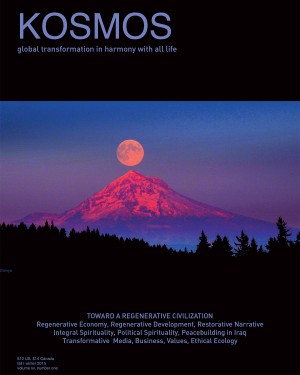
Subscribe to Kosmos Journal
Become a subscriber to Kosmos Journal today.
As a subscriber you will have access to the latest issue of Kosmos Journal.
Click here for more information.
Donate to Kosmos
We depend greatly on the generosity of donations from our readers to continue publishing this unique and timely Journal, website and bi-weekly newsletter.
Click here for more information.
|

By Medard Gabel
In the Current Edition of Kosmos Journal
Sustainable Development is a half-vast approach to vast problems. Its purpose, to make life on this planet sustainable, is a noble disguise for the maintenance of the status quo. When the status quo includes hundreds of millions of acres of degraded to destroyed farmland and leveled rainforest, depleted to exhausted fisheries and aquifers, toxic-choked streams, decreasing biodiversity, and a changing climate, sustainability is simply not acceptable. In short, sustainable development is like the bromide ‘do no evil’; it does not set the bar high enough. We can, and need, to do better than just sustain the unacceptable—or accept the present as the best we can do.
|

by The Center for Planetary Culture
in the current edition of Kosmos Journal
image: Richard Buckminster Fuller & Anne Hewlett Fuller Dome Home
The visionary design scientist Buckminster Fuller believed humanity faced a choice between ‘utopia or oblivion.’ According to Fuller, we will either establish a world where everyone on Earth receives a research grant for life in whatever subject interests them or we will fall by the wayside, like the vast majority of species before us. With the acceleration of our technological capacities and the deepening the critical threshold where we choose our path.
With our position paper and Wiki, we invite the global community to work with us to envision our current situation as an opportunity for an evolutionary leap, and document what lies beyond it.
|

This is a pre-release excerpt from the first chapter of
Designing Regenerative Cultures, by Daniel Christian Wahl, PhD
Publication Date: May 2nd, 2016 | Publisher: Triarchy Press, UK
Regenerative Cultures create win-win-win solutions by asking deeper questions
On an over-populated planet facing the threat of run-away climate change and the depletion of many non-renewable resources we currently depend upon, we are increasingly becoming aware of our interdependence. For our species to not just survive, but to thrive, we depend on each other and on the planetary life-support system.
|

Via Future of Fish and Green Wave
Each year, World Water Day highlights a specific aspect of freshwater. Under the theme ‘Water and Jobs’, the year 2016 provides an important opportunity to consolidate and build upon the previous World Water Days to highlight the two-way relationship between water and the decent work agenda in the quest for sustainable development.
Bren Smith is a former fisherman turned sustainable shellfish and seaweed farmer and entrepreneur. His company, Thimble Island Oyster Co., operates one of the first sustainable 3D ocean farms in the country.
Interview and multiple videos
|

By Bahadur Hāweatea Brysonon, via Elephant Journal
“When I started learning te reo Māori (the Maori language) I found my way home. The language is a treasure where even one ordinary word can provide immense understanding and wisdom. After all, the extraordinary hides in the ordinary. One word has me re-evaluating who I am.
With just 13 letters in the alphabet (8 consonants and 5 vowels), all words are deeply connected to each other. Vowels are seed sounds, across lands and cultures worldwide.
Makuini Ruth Tai, who teaches on the vibration of te reo Māori explains it as the language of nature, where REO (language) stands for Rich Earth Oratory. Six years ago she opened me up to seeing reo in this way, by explaining the first two words below. The other words are some I’ve sat with, outside in the fresh air, and tried to get to know. I share what they teach me, and it’s in no way conclusive.”
|

Special Announcement
The River Phoenix Center for Peacebuilding is offering a Community Peacebuilder Immersion Training Program. This two-week residential experience will provide the knowledge, skills, and support for inspiring and operationalizing peacebuilding practices in personal life and work, potentially creating a center for peacebuilding within the Participant’s community.
Kosmos Board Member, Dot Maver, will be facilitating along with other partners from the River Phoenix Center.
|
|
