---------- Forwarded message ----------
From: Kosmos Journal <info@kosmosjournal.org>
Date: Tue, Jul 15, 2014 at 7:06 PM
Subject: How Do We Live Together Now?
To: michelsub2004@gmail.com


Click here to read this newsletter on our website.
Kosmos Newsletter
JULY 15, 2014 NEWSLETTER
How Do We Live Together Now?

Dear Readers,

How do we live together now? This is a question that has been rattling around my head of late and I brought it with me when the Kosmos core team met in Lenox, Massachusetts last week.

In a way, it is a question that pervades a lot of what we do at Kosmos, and each of the five women who met for three days to laugh, cook, collaborate and reflect is devoting a substantial portion of heart and mind addressing it.

Dot Maver founder of The National Peace Academy and Global Alliance for Ministries and Infrastructures for Peace joins Kosmos Associates full-time this fall on the heels of a three year journey as Executive Director with the River Phoenix Center for Peacebuilding. She designed a program that radically reduced violence at the community level—now being sought to scale nationally. During our staff meeting she spent one evening by phone as guest faculty with James O’Dea’s Peace Ambassador Training addressing peacebuilding in community. Dot is dedicated to inspiring right human relations on behalf of the common good.

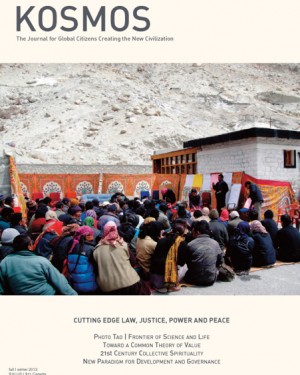
Don’t miss Dot’s article in the Fall/Winter issue of Kosmos.

Myra Jackson is Kosmos Director of Public Relations and one of our UN NGO representatives. She is working to introduce Kosmos to the 67 University NGOs at the UN, and as Media Director of the annual UN NGO Conference, is connecting us with global changemakers. In addition she is developing a Kosmos collaboration with the Omega Institute Conference on the Commons.

Board Member, Tara Stuart is an educator, speaker, author, and artist who has led numerous inter-cultural learning journeys to the Mexican Yucatan, India, Turkey, and frequently to Himalayan destinations in Nepal, Bhutan, Tibet and Mustang with Rinzin Sherpa, our newest Kosmos Global Ambassador. Tara always shares Kosmos Journal wherever she goes and just brims with humor, stories and wisdom.

And Editor Nancy Roof, of course, is well-known to most of you. She has worked generously for more than 50 years to promote personal transformation, sharing and peace. This fall, she will lead a Kosmos team to Findhorn, Scotland for the New Story Summit, already anticipated to be a watershed global event bringing together people of all ages and cultures ‘to support the emergence of a coherent new story for humanity and to produce practical, collaborative ways to live this new story.’

That leaves me, newly appointed digital editor- always carrying more questions than answers. As a mother, media maker, seeker and local activist, these questions mainly revolve around community. What makes communities resilient? How do we break down barriers, keep children safe, become more sharing, more tolerant, happier? What can we learn from nature and our own inner gifts that will help us on this incredible journey? How do we live together now?

That’s why it’s an honor and a joy to be part of the Kosmos family where questions like these are explored on a personal, local and global scale. With your collaboration, my hope is to develop the Kosmos website, newsletter and social presence to be uplifting, helpful and engaging, and to secure a place at the table with such remarkable women as Nancy, Tara, Myra and Dot.

Lastly, Findhorn Foundation has asked me to be a part of the film team documenting the New Story Summit, joining artists I greatly admire like Ian MacKenzie, Arnd Wachter, Sustainable Man Chris Agnos, and other media makers from Brazil, Africa and China. I have chosen ‘intentional community and civic engagement’ as my director’s theme. The media our team collects will be shared in many wonderful ways through special projects, blogs, and educational efforts by Findhorn, Kosmos and others.

That’s the news. I didn’t get a chance to tell you about the items in this edition of the newsletter, but in one way or another they have to do with living lightly on the earth. Hope you see something you like. And if you have thoughts, suggestions or ideas to share, reach me at rhondafabian@me.com. Much gratitude.

In partnership,
Rhonda Fabian
Digital Editor, Kosmos



Subscribe to Kosmos Journal

Become a subscriber to Kosmos Journal today.

As a subscriber you will have access to the latest issue of Kosmos Journal.

Click here for more information.


Donate to Kosmos

We depend greatly on the generosity of donations from our readers to continue publishing this unique and timely Journal, website and bi-weekly newsletter.

Click here for more information.


The Schumacher Center for New Economics and the American Institute for Economic Research are hosting and Kosmos Associates will be co-sponsoring and attending this talk by Peter Barnes, prominent spokesperson for the Commons. Look for an excerpt in the Fall/Winter edition of Kosmos Journal.

Peter Barnes – Economics for the Anthropocene
Sunday July 27, 2014, 7:30PM
Auditorium, American Institute for Economic Research, Division Street, Great Barrington, MA

Peter Barnes is an entrepreneur and writer who has co-founded and led several successful businesses and written numerous articles and books about capitalism, the commons and other topics. His latest book, With Liberty and Dividends for All: How to Save Our Middle Class When Jobs Don’t Pay Enough, proposes universal dividends from shared wealth as a practical solution to economic inequality.


The United Nations declared 2014 as the International Year of Family Farming. In this article, family farmers in Palau facing challenges, selectively adopt and adapt new approaches while trying to maintain their values.

By Robert V. Bishop

In the westernmost region of the Caroline Islands of Micronesia lies the Republic of Palau. Palauan traditional farming shows how agriculture, family values and culture are interconnected. Despite these connections, family farms are facing challenges. By joining forces, the small-scale family farms of these islands are standing up for their rights and calling for support for maintaining important (agri)cultural customs.


By Rick Clugston
IN THE CURRENT EDITION OF KOSMOS JOURNAL

Grim and Tucker argue that religions are entering their ecological phase and that religions should play a critical role in advancing a strong framework for sustainable development based on the convergence of these religious ecologies. Indeed, many religious communities already are contributing examples of compassionate and sustainable living.

Grim and Tucker define religious ecologies as “ways of orienting humans to the universe, grounding them in the community of nature and humans, nurturing them in Earth’s fecund processes, and transforming them into their deeper cosmological selves,” opening us toward “the creative force in the cosmos.” Religious ecologies provide ritual structures and ways of living that connect us to the community of life. Participants in the Harvard conferences identified seven key values for human-Earth flourishing that are shared by the world religions: reverence, respect, restraint, reciprocity, redistribution, responsibility and renewal. These values are foundational to religious ecologies.


A guide to using planning policy to meet strategic objectives through community food growing from Sustain.

This guide brings together in one place examples of planning policies around the UK that support community food growing.

It is aimed primarily at planning authorities to help them to use food growing as a way of creating healthy communities, but contains practical advice for all communities around the different issues that food growing helps to address, from sustainability to residential amenity via health and wellbeing, green infrastructure, regeneration and many other agendas. Within each section they document how food growing has been woven into planning policies to meet these priorities in local areas, and illustrate these with examples of growing projects that have also been set up to help meet that particular agenda. In some cases, such as in Brighton & Hove, the food growing spaces were set up as a direct result of planning policies, which have now led to over a third of new residential developments having integrated space for community food growing.


Copyright © 2014 Kosmos Associates Inc. All Rights Reserved.


This email was sent to michelsub2004@gmail.com
why did I get this?    unsubscribe from this list    update subscription preferences
Kosmos Associates · PO Box 2102 · Lenox, MA 01240 · USA

Web Bug from http://kosmosjournal.us3.list-manage.com/track/open.php?u=a2e6f01f29f00e615c1467a04&id=3b4d7a3e5c&e=60482295ca


--
Please note an intrusion wiped out my inbox on February 8; I have no record of previous communication, proposals, etc ..

P2P Foundation: http://p2pfoundation.net  - http://blog.p2pfoundation.net

Updates: http://twitter.com/mbauwens; http://www.facebook.com/mbauwens

#82 on the (En)Rich list: http://enrichlist.org/the-complete-list/